What Is Game Testing? 15 Types and When to Use Each

Rimpal MistryCo-Founder & VP Operations
 07/06/2026
Game testing identifies defects in a video game before players find them. A single broken quest trigger turns into refunds, 1-star reviews, and a damaged reputation within days of launch.
QA teams prevent this through 15 distinct testing types. Each type targets a different defect category, and each one runs at a specific point in development.
This guide defines game testing, explains all 15 types and techniques, and states when QA teams apply each one.
What is Game Testing?
Game testing is the process of identifying defects in a video game before release. QA teams validate gameplay mechanics, performance, compatibility, and player experience across platforms. The process spans 15 testing types grouped into 4 categories.
Wikipedia defines game testing as a software testing process for quality control of video games. Defect discovery and documentation form its primary function.
Documentation matters as much as discovery. A defect without reproduction steps costs developers hours; a documented defect costs minutes.
The stakes scale with the market. Newzoo’s 2025 Global Games Market Report projects $188.8 billion in global games revenue, with 3.6 billion players worldwide. Quality is the entry ticket to that market, not a differentiator.
How Does Game Testing Differ from Software Testing?
Game testing differs from software testing in what it validates beyond correctness. Standard software testing verifies that features work as specified. Game testing verifies a second layer: the experience is fun, balanced, and fair.
These properties never appear in a requirements document. A game can pass every functional check and still fail playtesting because level 3 bores players.
What Are the 15 Types and Techniques of Game Testing?
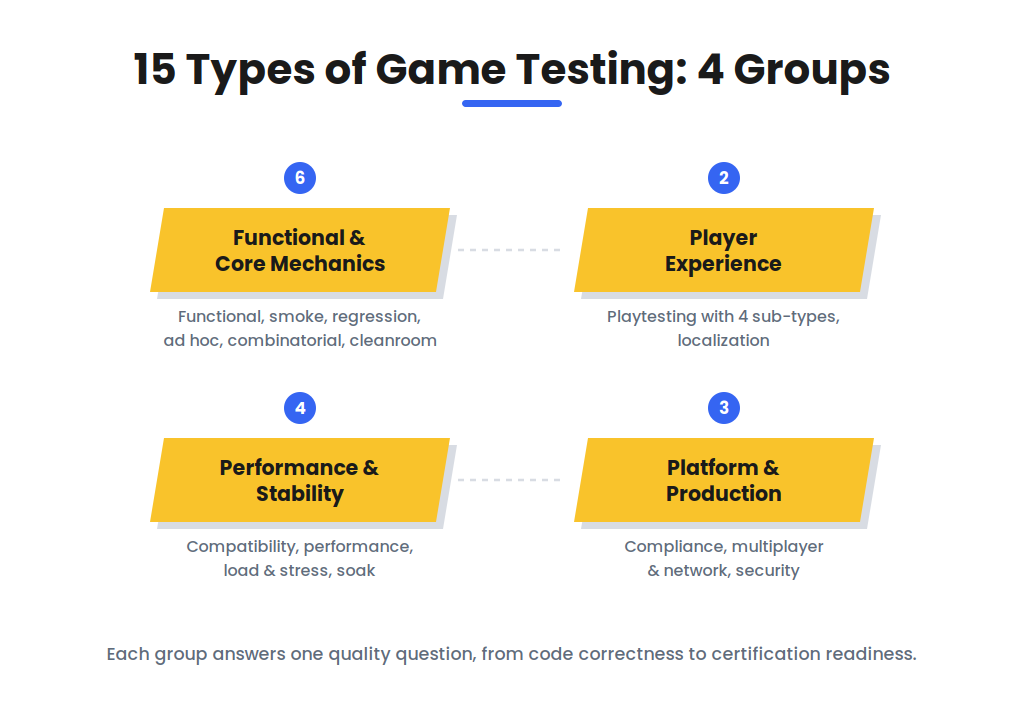
The 15 types of game testing fall into 4 groups: functional and core mechanics, player experience, performance and stability, and platform and production.
Each group answers a different quality question. The groups map to what each method evaluates, from code correctness through certification readiness.
| Group | Types | Quality question |
|---|---|---|
| Functional & Core Mechanics | Functional, smoke, regression, ad hoc, combinatorial, cleanroom | Does the game work as designed? |
| Player Experience | Playtesting, localization | Is the game enjoyable for every player? |
| Performance & Stability | Compatibility, performance, load & stress, soak | Does the game hold up under real conditions? |
| Platform & Production | Compliance, multiplayer & network, security | Is the game ready to ship and operate? |
Functional and Core Mechanics Testing
1. Functional Testing
Functional testing validates that game features behave exactly as designed. Game functionality testing covers mechanics, UI navigation, progression triggers, save systems, and audio-visual integrity. Testers verify every input, output, and game state transition against the design document.
Repeatable functional cases are strong candidates for Automated Functional Testing.
Run it continuously from the first playable build through release.
2. Smoke Testing
Smoke testing verifies basic stability after every new build. The check stays deliberately shallow: the game launches, menus respond, a level loads, and a save completes. A failed smoke test blocks the build from deeper testing.
Run it daily, before any regression cycle starts.
3. Regression Testing
Regression testing confirms that new code has not broken existing functionality. Live-service games depend on it most: every patch, season, and economy update risks reintroducing fixed defects. Automated regression suites cover high-risk areas such as login flows and in-game purchases.
Run it after every code change, and after every post-launch update.
4. Ad Hoc and Destructive Testing
Ad hoc testing hunts defects without scripts, plans, or documentation. Destructive game testing is its aggressive form: testers deliberately try to break the game through thousands of edge-case actions.
Walking into walls, spamming inputs during cutscenes, and force-quitting mid-save all belong here. Destructive user paths discovered after release damage the game; ad hoc testing finds them first.
Run it at multiple intervals across the development cycle.
5. Combinatorial Testing
Combinatorial testing reduces test case count by testing parameter combinations systematically. Game parameters include events, settings, gameplay options, character attributes, customization options, and hardware configurations. Pairing parameters catches interaction defects that single-parameter tests miss.
Run it when the test matrix grows too large for exhaustive coverage.
6. Cleanroom Testing
Cleanroom testing prevents defects instead of detecting them. Test cases derive from formal specifications, and defect patterns trace back to root causes through statistical reasoning. The method demands statistical and design knowledge, not programming skill.
Run it on projects where defect patterns repeat across builds.
Player Experience and Usability Testing
7. Playtesting
Playtesting is the process of evaluating gameplay flow, fun, and design against the original intent. Real players or testers play the game and report where it confuses, bores, or frustrates them. Playtesting carries direct business value because it measures user expectations before the market does.
Playtesting runs in 4 forms across development:
- Gross playtesting. The design team checks the first playable draft for gameplay smoothness.
- In-house playtesting. Proficient internal or contract gamers work through every gameplay aspect.
- Blind testing. Selected external players receive a beta version and log issues through surveys, with no prior exposure to the game.
- Final playtesting. Testers fine-tune aesthetics; game mechanics are locked at this stage.
Run gross playtesting at first draft, and the remaining forms progressively toward release.
8. Localization Testing
Localization testing verifies that translated versions of the game read, sound, and play correctly in every target region. Translation accuracy is half the job. Cultural sensitivity, format conventions, and UI integrity under longer text strings complete it.
Localization testing covers 2 attribute groups:
Language attributes:
- Spelling, grammar, and punctuation
- Numeric, date, currency, and metric formats
- Translation accuracy and language flow
- Voice-over alignment
- Culturally sensitive references and contextual mismatches
Visual attributes:
- Unrecognized characters (UTF rendering)
- Font rendering failures
- Text expansion breaking UI strings
- Visual placement and compliance issues
Run it before every regional release and after every content update touching text.
Performance and Stability Testing
9. Compatibility Testing
Compatibility testing validates the game across devices, operating systems, chipsets, and storefront platforms. Millions of device configurations exist; testing all of them is impossible. Isolating the configurations your players own makes the process tractable.
Mobile titles validate final builds through Real Device Testing on physical hardware.
Run it once the feature set stabilizes, and again before every platform launch.
10. Performance Testing
Performance testing measures frame rate, load times, memory usage, and battery consumption under defined conditions. Targets are numeric: 60 fps on the reference device, loads under 5 seconds, zero memory growth across sessions. Measurements on minimum-spec hardware matter more than flagship results.
Run it from the first optimized build, repeating after every major code change.
11. Load and Stress Testing
Load testing pushes the game toward its limits gradually; stress testing applies sudden spikes. Both reveal where servers crash, latency climbs, and matchmaking queues collapse. Simulated concurrent players expose the ceiling before launch day finds it publicly.
Run both before any launch involving online infrastructure, and before marketing events that spike player counts.
12. Soak and Stability Testing
Soak testing leaves the game running for 2 to 3 days. Extended runs expose memory leaks and gradual degradation.
Stability testing collects reliability data across the full test duration. Pausing for hours and resuming mirrors real player behavior.
Run them from the first complete build onward, in parallel with other test cycles.
Platform and Production Testing
13. Compliance and Certification Testing
Compliance testing validates the game against platform certification requirements before submission. Each console holder enforces its own standard: Sony’s Technical Requirements Checklist (TRC), Microsoft’s Xbox Requirements (XR), and Nintendo’s Lotcheck.
The O’Reilly book Modern Game Testing treats compliance as one of the 4 foundational game QA disciplines. A failed certification costs weeks of resubmission delay.
Run it before every platform submission, with a full pass reserved near content lock.
14. Multiplayer and Network Testing
Multiplayer and network testing validates synchronization, matchmaking, and gameplay fairness across connections. Latency, packet loss, host migration, and cross-platform sessions all change how the game behaves. Defects here are invisible in single-player test passes.
Run it for every title with online features, under degraded network conditions as well as clean ones.
15. Game Security Testing
Game security testing identifies exploits that enable cheating, economy manipulation, and unauthorized access. Testers probe for memory tampering, speed hacks, duplication exploits, and loopholes into restricted backend systems.
Games with real-money economies carry the highest exposure.
Run it at least once before release and after every post-launch update.
How Do Game Testing Types Map to Development Stages?
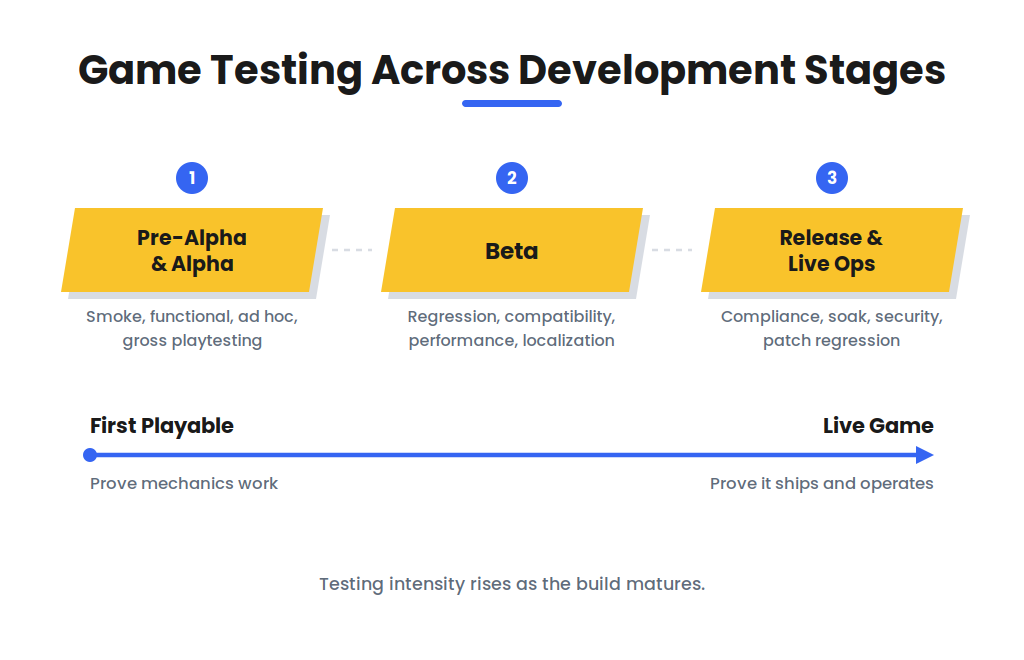
Game testing types map to development stages in 3 phases: pre-alpha and alpha, beta, and release with live operations.
Testing intensity rises as the build matures. Early stages emphasize functionality; later stages emphasize experience and production readiness.
| Stage | Primary testing types | Goal |
|---|---|---|
| Pre-alpha & alpha | Smoke, functional, ad hoc, gross playtesting, cleanroom | Prove core mechanics work |
| Beta | Regression, compatibility, performance, blind playtesting, localization, load & stress | Prove the game holds at scale |
| Release & live ops | Compliance, soak, security, multiplayer, regression on every patch | Prove the game ships and operates |
What Should QA Teams Check During Game Testing?
QA teams check 6 areas during game testing: user interface, gameplay mechanics, audio-visual quality, progression integrity, data persistence, and monetization flows.
Each area carries its own defect signatures.
- User interface. Menus, buttons, icons, and dialog boxes respond correctly across resolutions and input methods.
- Gameplay mechanics. Movement, combat, physics, and AI behave per design under normal and edge conditions.
- Audio-visual quality. Graphics render without corruption; audio syncs with events; subtitles match speech.
- Progression integrity. Quests trigger, levels unlock, and no state blocks the player from advancing.
- Data persistence. Saves, cloud sync, and profile data survive crashes, updates, and device switches.
- Monetization flows. Purchases complete, currencies credit correctly, and refund paths function.
Which Metrics Matter in Game Testing?
The 5 metrics that matter most in game testing are crash-free session rate, defect density, frame-rate stability, load time, and defect escape rate. Crash-free session rate above 99.5% is the common production bar. Defect escape rate measures what testing missed, which makes it the honest metric of QA effectiveness.
Which Tools Do Game Testers Use?
Game testers use 6 tool categories: engine-native frameworks, automation drivers, performance profilers, bug trackers, device clouds, and network simulators. Unity Test Framework handles engine-level automated tests for Unity titles. Unreal Automation does the same for Unreal Engine. Appium drives mobile game UI automation, JIRA tracks defects, and device clouds provide hardware coverage at scale.
Is Game Testing Manual or Automated?
Game testing combines manual and automated execution, with the split decided per testing type. Automation suits regression, smoke, performance, and load testing, where repeatability matters. Manual effort suits playtesting, ad hoc, localization, and compliance work, where human judgment decides.
Studios that automate the repeatable types free testers for the judgment-heavy ones.
What Are the Most Common Bugs in Game Development?
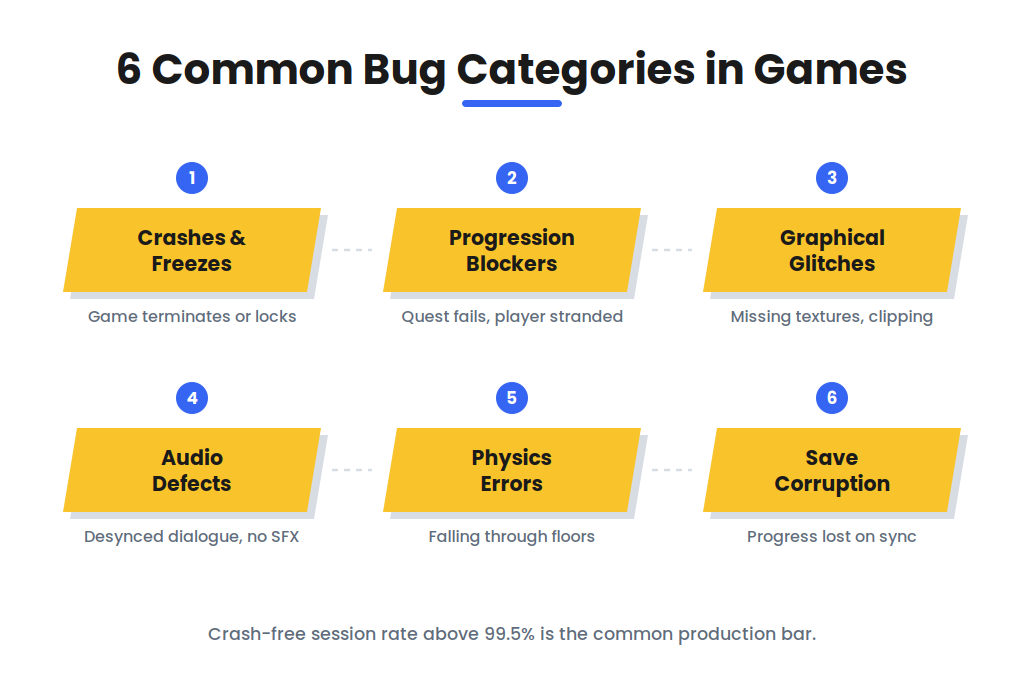
The most common bugs in game development fall into 6 categories: crashes, progression blockers, graphical glitches, audio defects, physics errors, and save corruption.
- Crashes and freezes. The game terminates or locks under specific actions or memory conditions.
- Progression blockers. A quest fails to trigger or a door fails to open, stranding the player.
- Graphical glitches. Missing textures, clipping models, broken animations, and lighting artifacts.
- Audio defects. Missing sound effects, desynced dialogue, and music failing to transition.
- Physics errors. Objects falling through floors, characters launched by collisions, and stuck states.
- Save corruption. Progress lost or corrupted on save, load, or platform sync.
How Does Professional Game Testing Fit into a Studio’s QA Strategy?
Professional game testing fits into a studio’s QA strategy as a dedicated capability spanning all 15 types across the development cycle. Small studios rarely staff every specialization in-house. Compliance, localization, device coverage, and load infrastructure are the 4 areas studios outsource first.
Testscenario provides game testing services for studios across mobile, PC, and console titles. Our QA teams combine functional and regression coverage with specialized passes for compatibility and performance.
Engagements draw on our Compatibility Testing and Performance Testing services, with device matrices built from each game’s player analytics. Every defect ships with reproduction steps, build version, and device details.

 24 Jul 2026