Blockchain Penetration Testing: Process, Attack Vectors, and Tools

Rimpal MistryCo-Founder & VP Operations
 28/05/2026
Blockchain penetration testing is the process of simulating adversarial cyberattacks against smart contracts, consensus mechanisms, and distributed ledger infrastructure to identify exploitable vulnerabilities before deployment to a live network.
Traditional application penetration testing covers servers, APIs, and frontend code. Blockchain penetration testing extends this to attack surfaces that only exist in decentralized systems; immutable smart contract logic, consensus manipulation, cross-chain bridge validation, oracle data feed integrity, and wallet key management. Each requires domain-specific tools and exploitation techniques.
Because deployed smart contracts cannot be patched, and DeFi protocols often hold millions in user funds, blockchain penetration testing is the final validation that separates audited code from production-ready code.
What Attack Vectors Does Blockchain Penetration Testing Cover?
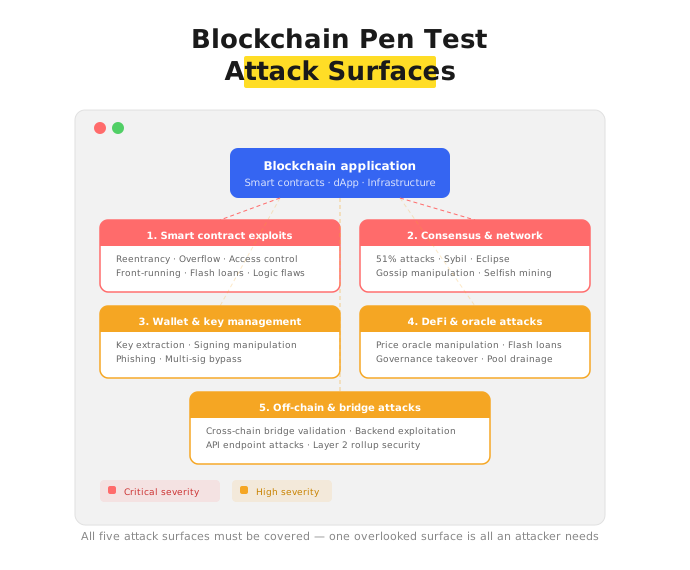
Blockchain penetration testers evaluate five attack surfaces across the application stack. Each targets a different layer of the decentralized system.
Smart Contract Exploits
Smart contract testing is the highest-priority activity in most blockchain penetration tests. Contracts execute autonomously, manage funds directly, and cannot be modified after deployment.
- Reentrancy: Recursive external calls drain funds before the contract updates its internal state. The attacker’s contract calls back into the withdraw function repeatedly within a single transaction. The 2016 DAO hack exploited this pattern for $60M in losses.
- Integer Overflow and Underflow: Arithmetic operations wrap around when they exceed a variable’s bounds. In token contracts, this produces unexpected balances; allowing attackers to mint tokens or bypass transfer limits.
- Access Control Bypass: Administrative functions missing proper role validation become callable by any address. This gives attackers the ability to pause contracts, drain reserves, or change critical parameters.
- Front-Running and Sandwich Attacks: Attackers monitor the mempool for pending transactions, then submit their own with higher gas to execute first. In a sandwich attack, the attacker front-runs a DEX swap to move the price, lets the victim trade at a worse rate, then back-runs to capture the difference.
- Flash Loan Exploits: Uncollateralized loans borrowed and repaid within a single transaction give attackers temporary access to massive capital. This capital is used to manipulate prices, swing governance votes, or drain liquidity pools, all before the transaction finalizes.
- Economic Logic Flaws: Protocol-specific business logic errors that emerge from unexpected interactions between functions, tokenomics, or governance mechanisms. These require deep understanding of the protocol’s economic model to identify and exploit.
Consensus and Network Attacks
Network layer penetration testing assesses whether the blockchain’s consensus mechanism and peer-to-peer infrastructure resist adversarial manipulation.
- 51% Attacks: An entity controlling majority hash power (PoW) or stake (PoS) can rewrite transaction history, double-spend tokens, and censor transactions. Pen testers assess the cost and feasibility for the specific network.
- Sybil Attacks: Creating large numbers of fake nodes to gain disproportionate influence over network decisions, validator selection, or governance outcomes.
- Eclipse Attacks: Isolating a target node by surrounding it with attacker-controlled peers. The eclipsed node receives only the attacker’s version of the blockchain, enabling targeted double-spending.
- Gossip Protocol Manipulation: Exploiting weaknesses in block and transaction propagation to delay, reorder, or censor specific transactions as they travel across the network.
Wallet and Key Management
Wallet penetration testing evaluates how the application protects private keys, signs transactions, and authenticates users.
- Private Key Extraction: Probing memory, storage, and network traffic for private key leakage through side-channel attacks, insecure storage, or unencrypted transmission.
- Transaction Signing Manipulation: Testing whether transaction parameters (recipient, amount, gas) can be altered between user approval and on-chain submission.
- Phishing and Blind Signing: Assessing whether users can be tricked into signing malicious transactions, especially in scenarios where wallets display raw hex data rather than human-readable transaction details.
- Multi-Signature Bypass: Testing multi-sig implementations for replay attacks, signature malleability, and threshold manipulation that could allow unauthorized fund movement.
DeFi and Oracle Manipulation
DeFi penetration testing evaluates the financial security of decentralized protocols alongside their technical security.
- Price Oracle Manipulation: Testing whether price feeds from Chainlink, Band Protocol, or Uniswap TWAP can be skewed through flash loans or large trades to trigger false liquidations or inflate collateral values.
- Flash Loan Governance Attacks: Borrowing tokens to temporarily accumulate voting power, passing a malicious proposal, and executing it, all within one transaction before the loan is repaid.
- Liquidity Pool Manipulation: Exploiting pool mechanics through large trades, just-in-time liquidity, or concentrated liquidity position manipulation to extract value from other participants.
Off-Chain and Bridge Attacks
Cross-chain bridges and off-chain infrastructure are the fastest-growing attack surface in blockchain security. Bridge exploits have caused billions in cumulative losses.
- Cross-Chain Bridge Validation: Testing the message verification logic that confirms source-chain transactions before releasing destination-chain funds. A single validation flaw can allow forged messages to drain the entire bridge.
- Backend and API Exploitation: Many dApps rely on centralized indexers, relayers, and admin panels. These components are tested with traditional web application techniques, injection, authentication bypass, privilege escalation.
- Layer 2 Rollup Security: Evaluating fraud proof mechanisms (optimistic rollups), validity proof systems (zk-rollups), and escape hatches for vulnerabilities that could lock funds or allow unauthorized withdrawals.
All five attack surfaces must be covered in a thorough engagement. An attacker only needs one overlooked surface to exploit.
How Does the Blockchain Penetration Testing Process Work?
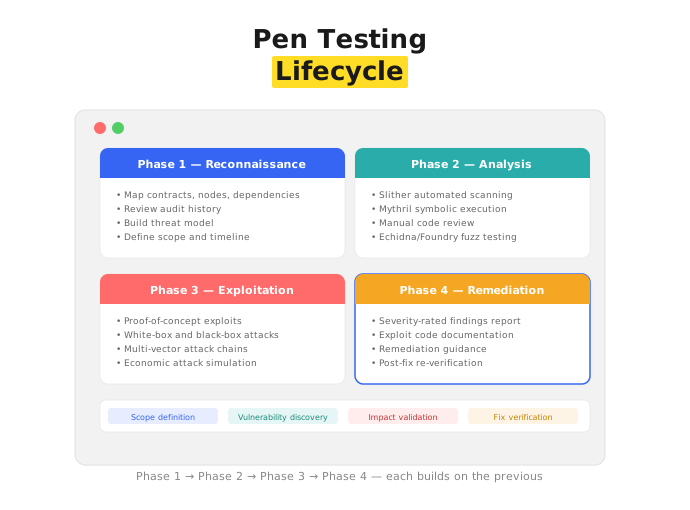
The blockchain penetration testing process follows four phases. Each phase is essential to a thorough blockchain testing engagement, building on the previous one, from reconnaissance through exploitation to remediation verification.
Phase 1: Reconnaissance and Threat Modeling
Mapping the complete attack surface before any active testing begins.
- Identify all smart contracts; addresses, functions, dependencies, and upgrade mechanisms.
- Document the blockchain platform, consensus type, and node infrastructure.
- Catalog every external integration; oracles, bridges, off-chain APIs, relayers.
- Review previous audit reports and publicly disclosed vulnerability history.
- Build a threat model that ranks each attack surface by potential financial impact.
- Define the testing scope, environment (testnet or mainnet fork), and timeline.
Phase 2: Static and Dynamic Analysis
Combining automated scanning with manual review to identify vulnerabilities before exploitation.
- Run Slither for automated Solidity vulnerability pattern detection.
- Run Mythril for symbolic execution targeting complex vulnerability paths.
- Conduct manual code review focused on business logic errors, economic exploits, and governance manipulation.
- Deploy contracts on a local chain (Hardhat or Anvil) and observe runtime behavior programmatically.
- Execute fuzz testing with Echidna or Foundry to discover edge cases through random inputs.
- Apply formal verification to critical contract invariants where scope permits.
Phase 3: Manual Exploitation
Simulating real attacks against identified vulnerabilities to validate exploitability and measure impact.
- Develop proof-of-concept exploits demonstrating real-world impact for each finding.
- Execute targeted attacks against contract functions, state transitions, and interaction patterns.
- Test multi-vector attack chains that combine multiple lower-severity issues into critical exploits.
- Simulate economic attacks exploiting protocol design; oracle manipulation, governance takeover, liquidity drainage.
- Assess consensus attack feasibility given the network’s current security parameters.
- Validate exploitation from both white-box (full access) and black-box (external only) perspectives.
Phase 4: Reporting and Remediation
Converting technical findings into prioritized, actionable fixes for the development team.
- Classify each finding by severity: Critical, High, Medium, Low, or Informational.
- Include complete proof-of-concept exploit code for every finding.
- Provide specific remediation guidance; concrete code changes, not generic recommendations.
- Re-test all vulnerabilities after fixes to verify effective remediation.
- Deliver a final report with executive summary and full technical documentation.
Critical findings mean direct financial loss with no user interaction required. All Critical and High findings must be resolved before any mainnet deployment.
What Tools Are Used in Blockchain Penetration Testing?
Blockchain pen testing requires specialized tools that target smart contract logic, EVM bytecode, consensus mechanisms, and decentralized application frontends.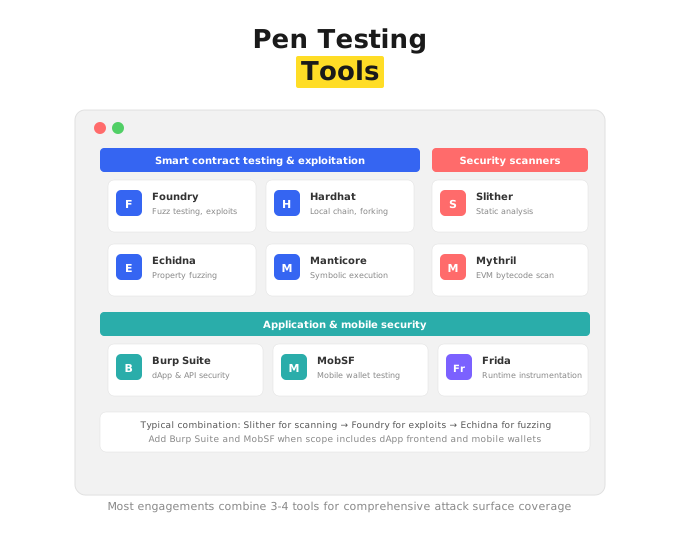
| Tool | Category | Role in Penetration Testing |
|---|---|---|
| Foundry | Fuzz testing and exploitation | Exploit development in Solidity, property-based fuzzing, mainnet fork attack simulation |
| Hardhat | Local chain and scripting | Attack scenario scripting in JS/TS, mainnet forking, custom network configuration |
| Slither | Static analysis | Automated Solidity vulnerability scanning, CI/CD pipeline integration |
| Mythril | Symbolic execution | EVM bytecode vulnerability detection, deep path analysis |
| Echidna | Property-based fuzzing | Random transaction sequences testing contract invariants |
| Manticore | Symbolic execution | Input generation for hard-to-reach code paths, constraint solving |
| Burp Suite | Web application security | dApp frontend testing, API endpoint exploitation, session analysis |
| MobSF | Mobile security | Mobile wallet application testing, API interception, binary analysis |
| Frida | Dynamic instrumentation | Runtime manipulation of mobile wallet apps, function hooking |
Most blockchain pen testing engagements use Slither for initial automated scanning, Foundry or Hardhat for exploit development and mainnet fork testing, and Echidna for invariant fuzzing. Application-layer tools like Burp Suite are added when the scope includes dApp frontends or APIs.
What Types of Blockchain Penetration Tests Exist?
Black Box Testing
No source code access. Testers interact with deployed contracts and the dApp exactly as an external attacker would; through public functions, the frontend, and bytecode analysis.
Simulates realistic attack conditions. May miss internal logic vulnerabilities not reachable through public interfaces.
Grey Box Testing
Partial access, typically smart contract source code without full internal documentation. The most common approach for blockchain penetration testing.
Balances external realism with code-level analysis. Testers identify source code vulnerabilities and validate whether they are exploitable externally.
White Box Testing
Full access to source code, architecture documentation, deployment scripts, and direct developer communication. The deepest possible analysis.
Most thorough and most resource-intensive. Used for high-value DeFi protocols and enterprise blockchain applications where the risk profile justifies comprehensive testing.
How Does Penetration Testing Differ From a Security Audit?
| Aspect | Penetration Testing | Security Audit |
|---|---|---|
| Approach | Simulates real adversarial attacks | Systematic code review against standards |
| Core question | Can these vulnerabilities be exploited? | Does this code follow security best practices? |
| Deliverable | Proof-of-concept exploits with severity ratings | Comprehensive findings report with recommendations |
| Perspective | Attacker mindset | Reviewer mindset |
| When | Pre-launch validation, periodic reassessment | Pre-launch review, after major code changes |
A security audit identifies vulnerabilities through systematic review. A penetration test validates whether those vulnerabilities are exploitable under real conditions. The strongest security posture requires both, an audit for coverage, a pen test for exploitation depth.
What Are the Most Common Blockchain Vulnerabilities?
These vulnerabilities are most frequently identified during blockchain penetration testing engagements.
- Reentrancy: Recursive calls that drain funds before state updates complete.
- Access Control Bypass: Privileged functions callable by unauthorized addresses.
- Integer Overflow: Arithmetic errors producing unexpected token balances.
- Front-Running: Pending transactions exploitable through mempool observation.
- Oracle Manipulation: Price feeds skewed through flash loans or large trades.
- Flash Loan Exploits: Economic attacks enabled by uncollateralized instant borrowing.
- Insecure Randomness: On-chain random numbers predictable by validators or miners.
- Signature Replay: Signed messages reused across chains or contract instances.
- Denial of Service: Functions forced to exceed block gas limits.
- Timestamp Dependence: Contract logic relying on manipulable block timestamps.
- Unchecked External Calls: Return values from cross-contract calls left unvalidated.
- Storage Collision: Proxy implementations where storage layouts conflict across upgrades.
Which Blockchain Platforms Require Penetration Testing?
Every blockchain platform has unique consensus mechanisms, smart contract languages, and attack surfaces. Penetration testing must account for platform-specific behavior.
Ethereum and EVM-Compatible Chains
Solidity contract testing, EVM bytecode analysis, gas optimization attacks, and MEV exploitation across Ethereum, Polygon, Arbitrum, Optimism, BNB Chain, and Avalanche.
Solana
Rust-based program security, account model vulnerabilities, cross-program invocation (CPI) exploits, and Solana-specific attack vectors including priority fee manipulation and account confusion.
Hyperledger Fabric
Permissioned blockchain security; chaincode vulnerability testing, channel configuration security, certificate authority assessment, and identity management.
Corda
Enterprise blockchain testing covering CorDapp vulnerabilities, notary service security, transaction privacy validation, and network map integrity.
When Should You Invest in Blockchain Penetration Testing?
Blockchain penetration testing is necessary when your project involves:
- Smart contracts managing, transferring, or locking user funds
- DeFi protocols depending on oracles, bridges, or governance mechanisms
- Cross-chain bridges validating and releasing value across networks
- Token launches, IDOs, or tokenized asset platforms
- Enterprise blockchain applications handling regulated or sensitive data
- Any decentralized application preparing for mainnet deployment
- Compliance requirements mandating independent security validation
Penetration testing catches vulnerabilities that automated tools and internal code review miss. It validates that your application withstands real adversarial pressure, not just theoretical vulnerability patterns.
Explore our blockchain testing services →
Frequently Asked Questions
How long does blockchain penetration testing take?
Most engagements complete in 1-3 weeks from kickoff to final report delivery.
What is the difference between a pen test and a security audit?
A security audit reviews code against known patterns. A pen test simulates real attacks to validate whether vulnerabilities are exploitable in practice.
Do I need pen testing after a security audit?
Yes. Audits identify code-level issues. Pen testing validates real-world exploitability and covers attack vectors audits miss; infrastructure, wallet integration, and multi-step economic exploits.
What qualifications should blockchain pen testers have?
OSCP, OSWE, or GWAPT certifications combined with hands-on blockchain security experience, smart contract tool proficiency (Slither, Mythril, Echidna), and participation in bug bounty programs like Immunefi or Code4rena.
How often should pen testing be performed?
Before every mainnet deployment, after significant code changes, and at minimum annually for production protocols.

 29 Nov 2024


