Dedicated QA Team vs Staff Augmentation vs Managed QA: How to Choose

Rimpal MistryCo-Founder & VP Operations
 19/11/2026
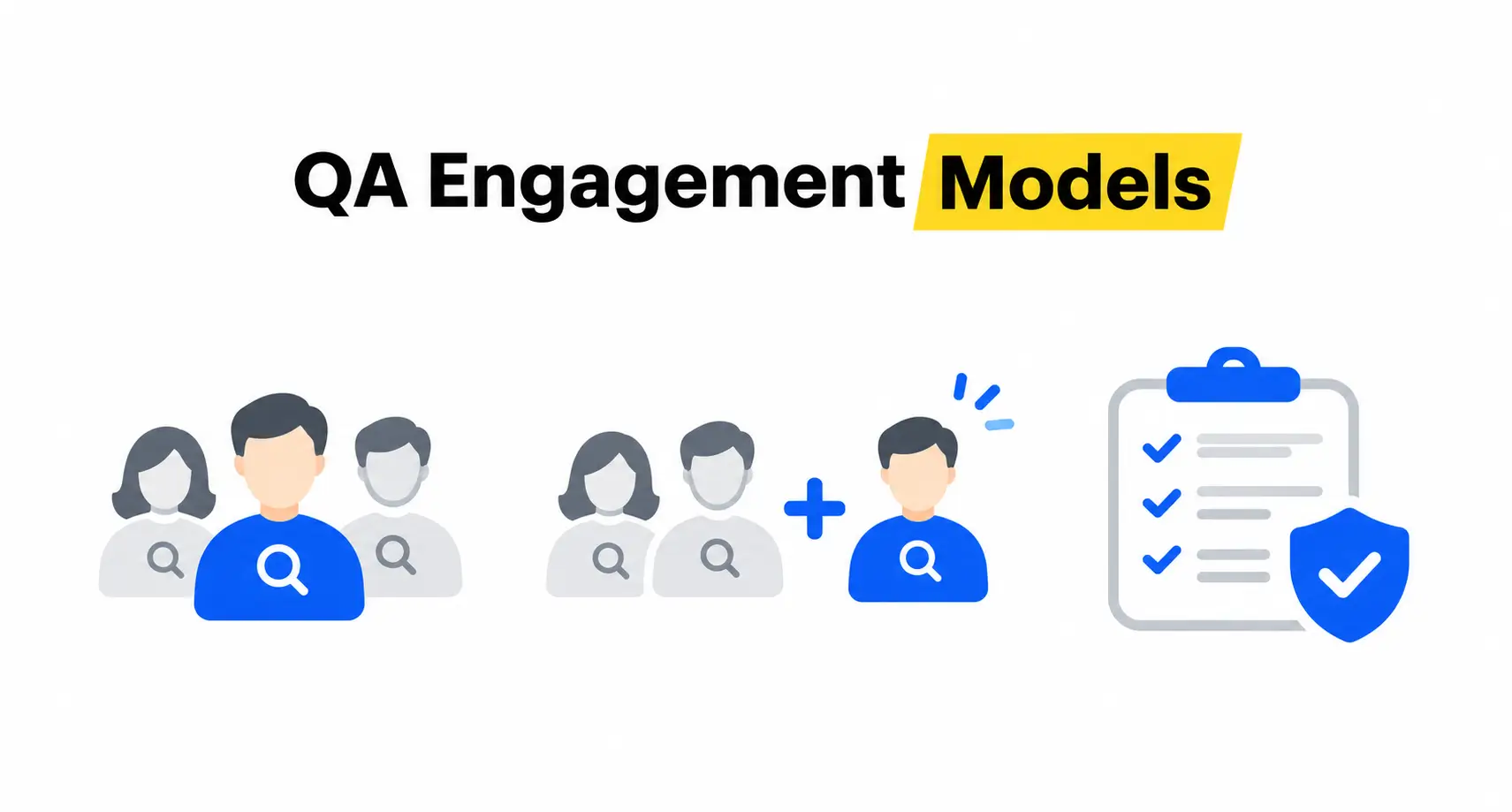
A dedicated QA team, staff augmentation and managed QA differ in two things: who directs the testers, and who answers for quality when anything goes wrong.
Staff augmentation adds testers that you manage.
Dedicated QA team adds a testing unit that has its own QA lead and works only on your product.
Managed QA makes the vendor responsible for testing outcomes which is measured against agreed SLAs.
In All three models you put outside testers to work on your product. What changes is how much of the testing function you hand over.
With staff augmentation, you hand over hiring and nothing else. With a dedicated QA team, you also hand over the planning and the daily running of QA. With managed QA, you hand over the outcome itself.
| Question | Staff augmentation | Dedicated QA team | Managed QA |
|---|---|---|---|
| Who assigns the testers’ work each morning | Your engineering manager or QA lead | The team’s QA lead, working from your sprint priorities | The vendor’s test manager |
| Who decides what gets tested, and how deeply | You | The QA lead proposes and you approve | The vendor, within the agreed scope |
| Who answers for a bug that reaches production | You | Shared: the team explains the gap, and you own the release decision | The vendor, because it counts as an SLA miss |
| How you pay | Per tester, monthly or hourly (time and materials) | One monthly fee for the whole team | A fixed fee per scope, release or SLA level |
| Where test cases and automation code live | In your tools and your repository | In your tools and your repository | Often in the vendor’s tools, so check the contract |
| What happens when a tester leaves | Product knowledge leaves with them, unless the vendor runs a handover | The team keeps the knowledge and brings the replacement up to speed | You don’t see it, because the vendor staffs to meet the SLA |
| Your weekly management time | Highest | Moderate: setting priorities and reviewing results | Lowest, once scoping is done |
| Fits best when | You have QA leadership and need more hands | You release often, have no QA lead, and have a long roadmap | Nobody in-house can own testing, or the scope has clear edges |
In each one of them comes back one trade-off. The more control you keep over testing, the more management work you keep with it. So the companies that choose the wrong model usually misjudge that second half.
They pick staff augmentation for the control, then find nobody has time to direct the testers. Or they pick managed QA to save time, then find they can’t steer the testing when priorities change in the middle of a sprint.
What Are the Three QA Engagement Models?
The three QA engagement models are:
- Staff augmentation
- Dedicated QA team
- Managed testing services
They split three things differently between your company and the vendor: who directs the testers, who owns the test assets, and who carries the risk when quality slips.
The names get used loosely. Some vendors call one embedded tester a “dedicated QA”. Others use “managed services” for any outsourced work at all. The definitions below are based on how control and accountability actually work in each model. so you can recognise a model by what it does, whatever a vendor calls it.
What Is QA Staff Augmentation?
QA staff augmentation is an engagement model where a vendor supplies one or more testers who join your existing team.
Core things:
- They work under your managers and follow your processes and tools.
- You direct their daily tasks and own the test strategy and results.
- The vendor handles hiring, payroll, replacements and HR administration.
In practice, an augmented tester is part of your sprint from the first day. The tester joins your standup, picks stories from your Jira board, writes test cases in your test management tool and raises bugs straight to the developer who wrote the code.
Nobody on your side translates between “your team” and “the vendor”, because the tester sits inside your team in every way that matters to the work.
This model is also called a dedicated QA, or a dedicated tester, because one person works only on your product. At TestScenario, it is the most-requested engagement: one tester working with the client’s developers, directed by the client.
Speed is the main reason companies choose it. At TestScenario, candidate profiles reach the client within 24 hours of the first call, and the selected tester starts within 48 hours of a signed agreement. No process needs designing first, because the tester follows yours.
What Is a Dedicated QA Team?
A dedicated QA team (also called an extended QA team) is a group of testers, led by its own QA lead.
A vendor assigns it to one client only and mostly for the long term. The team learns one product in depth and follows the client’s roadmap and release cadence. Its reporting happens through the QA lead, while the vendor manages other things.
The QA lead is what separates a dedicated team from a set of augmented testers. The lead plans each test cycle and decides which regression suites run before which release.
The lead tracks where defects cluster and tells your product owner whether a build is ready to ship. The lead also decides when a manual check has run often enough to be worth automating. Your engineering managers stop directing testers and go back to directing developers.
A dedicated QA team also mixes skills in a way a single tester can’t. One team can hold a manual tester who knows every user flow, an automation engineer who maintains the regression suite, and someone who handles API or performance testing, all working to one plan.
What Are Managed Testing Services?
Managed testing services (managed QA) is an outsourcing model where a vendor owns testing outcomes for a defined scope.
The vendor or company plans the test strategy and chooses the team size and tools. It carries out the testing and reports against agreed SLAs, such as test coverage, defect leakage and turnaround time per release.
With managed testing services you buy a result, not people. You don’t interview testers or assign their work. You agree what “tested” means for each release, and the vendor delivers to that definition.
Your team’s effort moves to the start of the engagement: writing the scope, agreeing the SLAs, and deciding what the vendor’s reports have to show. After that, your contact with testing comes mostly through those reports.
Managed QA works well for testing with clear edges. A load test before a traffic peak, a security review against the OWASP Top 10 before an audit, or a full regression pass on a platform migration all have a defined start, a defined end and a measurable result.
Staff Augmentation vs Managed Services: What Is the Difference?
Staff augmentation sells you testing capacity, and managed services sell you testing outcomes. That one difference changes who plans the testing, what the contract measures and who you call when a release goes wrong.
| Factor | Staff augmentation | Managed services |
|---|---|---|
| What you buy | Testers’ hours and skills | A tested release, or a testing function |
| Who plans the test strategy | Your QA lead | The vendor’s test manager |
| Who you call when a bug escapes | Your own QA lead | The vendor’s account manager |
| What the contract measures | Availability and hours | Coverage, defect leakage and turnaround time |
| How scope changes are handled | You redirect testers the same day | Through a change to the statement of work |
| What it costs you to manage | Daily direction from your managers | Up-front scoping, then reviewing reports |
| Pricing | Time and materials, per tester | Fixed fee or SLA-based |
| Right for | Teams with QA leadership and a capacity gap | Teams without a QA owner, or a scope with clear edges |
The “who you call” row matters more in QA than in most outsourcing. Under staff augmentation, a payment bug that reaches production means your process missed it, and your QA lead runs the retrospective. Under managed services, the same bug is an SLA breach, and the vendor has to explain in its next report how the defect got past its test plan.
The scope-change row matters just as much in fast-moving teams. Your product owner moves a feature into this sprint on a Tuesday. An augmented tester starts testing it on Tuesday afternoon. Under a managed services contract, the same change goes through the vendor’s scope process first, because the vendor committed to SLAs on a different scope.
Is Staff Augmentation Considered Outsourcing?
Yes, staff augmentation is a form of outsourcing, but only the hiring and employment are outsourced, not the work itself.
The vendor employs the testers, while your team directs what they test and how. Managed services outsource the work as well, which is why people call them full outsourcing.
Dedicated QA Team vs Staff Augmentation: Which Gives You More Control?
Staff augmentation gives you more direct control, because each tester takes instructions from your managers. A dedicated QA team gives you less day-to-day control. In return you get a QA lead, a working test process, and product knowledge that stays when one person leaves.
| Factor | Staff augmentation | Dedicated QA team |
|---|---|---|
| Who sets each tester’s daily tasks | Your manager | The team’s QA lead |
| Who builds the test process | You | The team |
| Who reports release readiness | Your QA lead, if you have one | The team’s QA lead |
| Where product knowledge sits | With each tester | In shared test suites, documentation and the team as a whole |
| What a departure costs you | Lost context, unless the vendor runs a handover | A replacement that the team brings up to speed |
| What you manage | People and tasks | Priorities and results |
| Skill mix | The skills of the testers you picked | Manual, automation and specialist testing under one plan |
Knowledge retention decides more of these comparisons than buyers expect. A tester who has worked on your product for a year knows which modules break after every release and which test cases are out of date. That tester also knows why a strange edge case in the checkout flow has its own regression test. None of this is written down anywhere complete, and it’s the reason an experienced tester finds in an hour what a new tester finds in a week.
Prodo shows what that knowledge adds up to over time. Prodo is a UK digital agency, founded in 1998, that builds self-service portals, mobile apps and lettings platforms for housing associations. It has worked with TestScenario for eight years. In that time, the testers documented more than 1,500 bugs across dozens of applications in active development.
They also took test coverage from ad hoc manual checks to over 95% across key modules. Much of that work ran on legacy modules with gaps in their documentation. On modules like those, testers who already know the product don’t need the missing documents to find what’s broken. The full story is in the Prodo case study.
TestScenario protects that knowledge the same way in both models. Replacement testers are assigned immediately, and a defined knowledge-transfer process runs whenever a tester changes. In a dedicated team there is a second layer of protection: the QA lead and the remaining testers carry the context, so the new tester learns the product from colleagues, not from scratch.
Who Owns Test Strategy, Test Cases and Automation Code in Each Model?
Ownership of test assets moves from you towards the vendor as you go from staff augmentation to managed services. Settle ownership before signing, because test cases and automation code are what let you change vendors, or bring testing in-house, later.
| Test asset | Staff augmentation | Dedicated QA team | Managed testing services |
|---|---|---|---|
| Test strategy and test plan | Written by you | Written by the QA lead and approved by you | Written by the vendor |
| Test cases | In your tool | In your tool | Often in the vendor’s tool |
| Automation code | In your repository | In your repository | Sometimes in the vendor’s own framework |
| Defect history | In your bug tracker | In your bug tracker, plus QA lead reports | In vendor dashboards and SLA reports |
| Product knowledge | With each tester | With the team | With the vendor’s delivery team |
Test assets build up quietly. After a year of testing, a product can have hundreds of test cases, an automated regression suite and a defect history that shows where the code is weakest. That collection is often worth more than any single month of testing, and it belongs in a system you control.
Under managed testing services, write three terms into the contract: test cases exported in a standard format, automation code committed to your repository, and a handover period agreed in writing for when the contract ends.
Without these three terms, switching vendors means rebuilding your regression suite from nothing. Under all three models, sign the NDA and IP terms before any tester sees your code. TestScenario signs both before work starts.
What Are the Pros and Cons of Each QA Engagement Model?
Each QA engagement model trades control against management effort, and that trade-off produces its pros and cons.
QA staff augmentation
- Pro, fast start: Candidate profiles in 24 hours and a tester working within 48 hours of signing are achievable, because no process has to be built first.
- Pro, full control: You decide what gets tested, in what order and how deeply.
- Pro, flexible size: With a one-month minimum engagement and one month’s notice, you can match the number of testers to your release calendar.
- Con, management load: Somebody on your side directs the testers every day, and that time comes out of engineering leadership.
- Con, knowledge risk: Context leaves with a tester unless the vendor runs a proper handover.
- Con, the risk stays with you: You pay for testing time whether or not each release meets its quality bar.
Dedicated QA team
- Pro, built-in leadership: The QA lead plans the testing, so your engineering managers stop scheduling test cycles.
- Pro, deep product knowledge: The team tests the same product across many releases and learns where it breaks.
- Pro, mixed skills: Manual testing, API testing and automation sit inside one team, under one plan.
- Con, more roles to align: A lead and several testers take longer to settle into your workflow than one tester does.
- Con, less granular control: You set priorities, but the QA lead assigns the tasks.
- Con, built for continuity: The model pays off over many releases. A short one-off project rarely justifies building a team.
Managed testing services
- Pro, least management: You define the goals and the SLAs, and the vendor runs the work.
- Pro, measurable results: Coverage, defect leakage and turnaround time come back every release.
- Pro, the vendor carries the risk: Hiring, tools and staffing gaps are the vendor’s problem.
- Con, rigid scope: Changing direction mid-contract means changing the statement of work.
- Con, slower start: Discovery and scoping come before any testing.
- Con, distance from your developers: Feedback reaches your team through reports and tickets, not in standups.
None of these cons rules a model out. Each one tells you what to plan for. A staff augmentation engagement needs a named person on your side to direct the testers. A dedicated team needs a settling-in period built into the first release plan. A managed engagement needs a scope document written carefully enough that the SLAs measure what you actually care about.
Which QA Model Fits Your Team and Release Cadence?
Three things decide which model fits: how often you release, whether you have someone to lead QA, and whether the testing need is ongoing or has a clear end.
| Your situation | Model that fits | Why |
|---|---|---|
| A QA lead is in place, but untested stories pile up before each release | Staff augmentation | Your lead directs the extra testers, and no process needs building |
| You release every sprint, have no QA lead, and developers test their own code | Dedicated QA team | The team brings a lead, a process and a regular regression routine |
| A product launch or seasonal peak lasting a few months | Staff augmentation | Testers join for the surge, and a one-month notice period lets you scale back afterwards |
| A one-time migration, compliance check or performance test | Managed testing services | The scope has clear edges, so the vendor can own the outcome |
| Regression testing no longer fits between code freeze and release day | Dedicated QA team | Regression now needs automation and a lead to plan it |
| You need wide device and browser coverage, and you have no device lab | Managed testing services or a dedicated QA team | The vendor supplies the devices or the device cloud, and plans the coverage |
The regression row is where many teams first feel the limits of their current model. PLAI Sport, a team management platform built by Yellow Panther for community sports organisations, was averaging 6 to 8 defects reaching production per release. The product had to keep player availability, attendance and fee payments in sync between mobile and web, across more than 5 languages and 3 currencies.
Manual regression couldn’t cover that. TestScenario built more than 150 reusable automated regression test cases and ran 4 UAT cycles with real coaches across 3 regions. Test coverage rose from about 40% to over 90% across key modules, and defect leakage fell by 70%. The full story is in the PLAI Sport case study.
Two questions settle most borderline cases. First, does someone in your company have time to direct testers every day? Second, will this testing need continue past the current project? Two yeses point to staff augmentation. A no to the first and a yes to the second point to a dedicated QA team. A no to both points to managed testing services.
What Should You Ask a QA Vendor Before Choosing a Model?
Ask a QA vendor nine questions before choosing a model. They cover how fast it starts, how long you’re committed, how you exit, how it replaces people, how knowledge moves between testers, whether you can trial it, how much your working hours overlap, and who owns what the testers produce.
The answers show whether the model works with that vendor in practice, not only on paper. TestScenario’s own answers are in the right-hand column as a reference point.
| Question to ask | Why it matters | TestScenario’s answer |
|---|---|---|
| How soon after the first call do I see candidate profiles? | Shows whether the vendor has testers ready or has to recruit them first | Within 24 hours |
| How soon after signing does a tester start? | Decides whether the vendor helps with this release or the next one | Within 48 hours |
| What is the minimum engagement? | A short minimum makes staff augmentation safe to try | 1 month, then as long as the client needs |
| What notice do I give to end or scale down? | Decides how quickly you can shrink after a peak | 1 month |
| How quickly is a tester replaced? | A gap in testing is a gap in your releases | Immediately |
| What happens to product knowledge when a tester changes? | Protects you from the knowledge loss described above | A defined knowledge-transfer process |
| Can I test the arrangement before committing? | Lowers the risk of a wrong first choice | A 15-day pilot project |
| How many of my working hours overlap with the team’s? | A bug found in your afternoon gets fixed that day, or a day late | The team works until 1 am IST, which covers the full UK working day and the US Eastern morning and early afternoon |
| Is there an NDA and IP agreement? | Decides who owns what the testers produce | Both are signed before work starts |
A vendor that can’t answer these in writing will struggle with any of the three models. Pay most attention to the answers on replacement and knowledge transfer. Every engagement loses a tester eventually, and those two answers decide whether that week is a hiccup or a reset.
How to Choose a QA Engagement Model: Checklist
To choose a QA engagement model, count how many statements in each block match your company. The block with the most matches is your starting model.
Choose QA staff augmentation when:
- [ ] You have a QA lead or engineering manager who can direct testers every day.
- [ ] Your QA process, test cases and tools already exist.
- [ ] You need one or two extra testers, or one specific skill such as mobile testing or automation.
- [ ] You want testers in your standups, Jira board and Slack channels.
Choose a dedicated QA team when:
- [ ] Your product releases every sprint, and the roadmap runs well beyond the current project.
- [ ] You have no QA lead and want one included.
- [ ] You need manual, API and automation testing in one group.
- [ ] You want product knowledge to stay when one tester leaves.
Choose managed testing services when:
- [ ] Nobody on your side can own the test strategy.
- [ ] You want to pay for outcomes, such as coverage and defect leakage, not for hours.
- [ ] The testing scope has clear edges, such as a release, a migration or a compliance check.
- [ ] You want the least possible management work.
A tie between two blocks usually means you’re in transition: your company is growing out of one model and into the next. That is normal, and it leads to the next question.
When Do Companies Switch QA Engagement Models?
Companies switch QA engagement models when management load, release frequency or product size outgrows the current setup. The usual path has four stages:
- Developers test their own code. This lasts until bugs start reaching customers and the support queue becomes the test report.
- One augmented tester joins. A single tester takes over story testing and regression, directed by an engineering manager.
- The engineering manager can’t keep directing testers. Regression stops fitting before release day, testers wait for instructions, and bugs still escape. This is the point to move to a dedicated QA team, whose QA lead takes over planning, automation priorities and quality reporting.
- Specialist scopes go to managed services. Performance testing before peak traffic, security testing before an audit, or accessibility testing before a compliance deadline runs as a fixed-scope managed engagement next to the core team.
At TestScenario, the most-requested engagement is stage 2: one dedicated tester working inside the client’s team. Managed QA is the second most requested, and full dedicated teams the third.
Procure shows how one engagement changes shape as a product grows. Procure is a procurement and inventory platform for non-profits, including schools, universities and hospitals. TestScenario started with Procure in April 2017 at the requirements-planning stage. At that point the testing centred on a fixed go-live date, and pre-launch testing time was short.
After launch, the work moved to continuous, sprint-based QA running alongside development. The team added automated regression with Selenium and JUnit, load testing with JMeter, and security testing with OWASP ZAP. Over five years, up to June 2022, the team identified and resolved more than 2,000 issues, raised load capacity by 30% and cut downtime risk by 20%. Most high-severity defects sat at the third-party API boundaries, where Procure connects to ERP systems, CRM platforms and payment gateways. The full story is in the Procure case study.
The pattern in Procure’s story is the general one. The testing a product needs before launch is not the testing it needs three years later. A good engagement model is the one that fits the product’s current stage, with a clear way to move to the next model when the product outgrows it. To compare engagement terms for each stage, see our QA outsourcing services.
Should QA Stay In-House Instead?
Keeping QA in-house is a separate decision that comes before choosing an outsourcing model. In-house testers give you the deepest product knowledge and complete control. They also cost a full salary plus benefits, take a full hiring cycle to recruit, and leave you to carry the cost of attrition.
Many companies keep one in-house QA lead and use one of the three models above for execution, so they get in-house ownership of quality and outsourced capacity in one setup.
Not sure which QA engagement model fits your release cycle?
TestScenario has run QA engagements since 2014, with 55 QA engineers averaging 3.5 years of experience, and a 4.9 rating on Clutch from 17 reviews. Start with a one week pilot project, and get candidate profiles within 24 hours of your first call.

 09 Jul 2026


