Managed QA Services: The Complete Guide for Enterprise Teams

Rimpal MistryCo-Founder & VP Operations
 10/08/2026
We have managed QA operations for edtech platforms, food delivery apps, and enterprise non-profit systems. Every engagement starts with the same conversation. The internal team is stretched. Releases are slipping. Production bugs are costing more than anyone admits.
Managed QA solves this by moving full testing ownership to an external provider. The provider owns strategy, execution, tools, team, and quality outcomes. Accountability runs through Service Level Agreements (SLAs). Not timesheets.
This guide covers what managed QA services include and why enterprise teams adopt the model. It walks through pricing, SLA benchmarks, and how to evaluate providers.
What Are Managed QA Services?
Managed QA services are an outsourced model that transfers testing ownership to a single external provider. The provider plans, executes, governs, and improves the entire testing function. Accountability ties to Key Performance Indicators (KPIs) and SLA targets.
Managed QA services differ from basic outsourcing in one respect. Ownership.
The provider controls the testing process itself:
- Test strategy and coverage design.
- Tool selection and environment provisioning.
- Team hiring, training, and retention.
- Continuous improvement based on defect trend data.
The client sets quality standards. The vendor delivers measurable results against those standards.
📋 ISTQB Definition: The ISTQB CTFL Syllabus defines testing as evaluating a component or system against specified requirements.
Managed QA operationalises that definition as a service.
How Does Managed QA Differ from Other Testing Models?
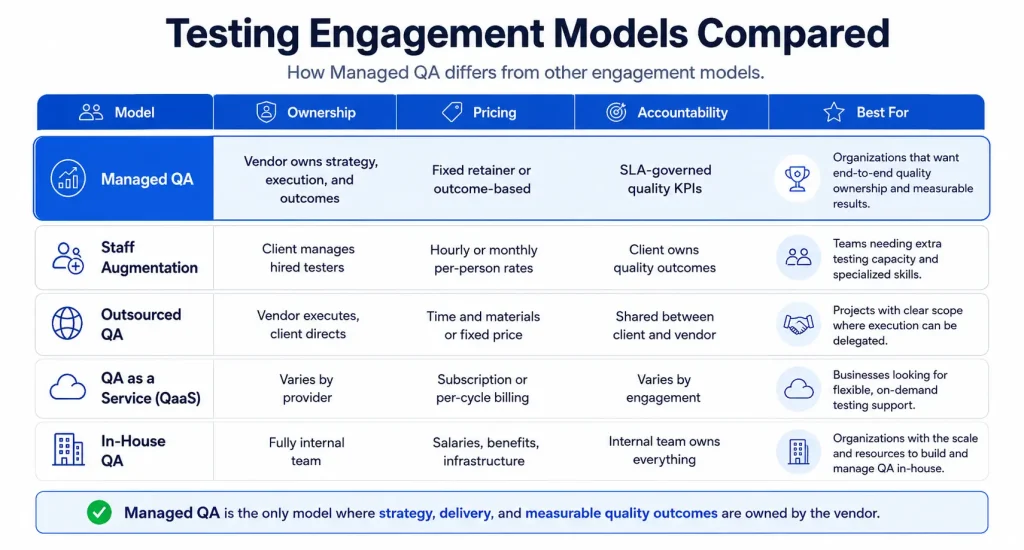
Managed QA occupies one position among 5 engagement models. The table below separates each by ownership, pricing, and accountability.
| Model | Ownership | Pricing | Accountability | Best For |
|---|---|---|---|---|
| Managed QA | Vendor owns strategy, execution, outcomes | Fixed retainer or outcome-based | SLA-governed KPIs | Teams replacing an entire QA function |
| Staff Augmentation | Client manages hired testers | Hourly or monthly per-person | Client owns quality outcomes | Teams needing extra capacity |
| Outsourced QA | Vendor executes, client directs | Time-and-materials or fixed price | Shared | Project-based testing with defined scope |
| QA as a Service (QaaS) | Varies by provider | Subscription or per-cycle | Varies by engagement | On-demand testing for specific releases |
| In-House QA | Fully internal | Salaries, benefits, infrastructure | Internal team owns everything | Stable, predictable QA needs |
💡 Key Distinction: The defining line is ownership. Managed QA transfers operational ownership. Staff augmentation and outsourced QA keep ownership with the client.
In our experience, the ownership question determines engagement success more than team size or tool selection. Blurred ownership creates gaps. Defects escape. Nobody owns the miss.
The ownership model shapes what the engagement delivers. The 5 components below define the full scope.
What Does a Managed QA Engagement Include?
Managed QA engagements are built on 5 core components. Each operates under SLA-backed accountability. The provider delivers all 5 as a unified quality operation.
The 5 components:
- Test strategy and planning.
- Team assembly, training, and retention.
- Test execution and automation.
- Infrastructure, tools, and environment management.
- Reporting, defect tracking, and governance.
Test Strategy and Planning
The test strategy starts with one question: what breaks first when this application fails?
We map every client’s release calendar against their risk exposure before writing a single test case. Strategy covers 4 areas:
- Test scope and coverage model definition.
- Risk-based test prioritisation across modules.
- Automation feasibility assessment per feature area.
- Testing cadence mapping to sprint and release schedules.
Every test cycle traces back to documented business requirements. The strategy evolves quarterly based on defect trends and coverage data.
Team Assembly, Training, and Retention
The provider recruits, trains, and retains the testing team. QA engineers, automation specialists, and test leads join based on project requirements. The client reviews profiles and approves every hire.
Retention sits entirely with the provider.
This matters. One departing automation engineer takes 3-6 months of regression knowledge with them.
We build documented runbooks for every managed QA engagement. Attrition is not a question of “whether.” It is a question of “when.”
Test Execution and Automation
Execution spans manual testing, automated regression, integration validation, and specialised testing types. The provider runs every test cycle. Every failure is triaged before it reaches the client.
The client receives triaged bug reports. Not raw test logs. This distinction matters more than most teams realise. We have seen engineering teams waste entire sprint days chasing false positives from untriaged automation output.
Automation coverage grows incrementally. The provider builds and maintains frameworks, scripts, and data sets. Regression suites run on every build through Continuous Integration/Continuous Delivery (CI/CD) pipelines.
Infrastructure, Tools, and Environment Management
The provider provisions test environments, device labs, automation frameworks, and test data pipelines. Tool licensing costs sit with the provider. Environment parity with production is the provider’s deliverable.
Test data management is the most underestimated infrastructure responsibility. The provider generates, masks, and refreshes data across environments. Stale data causes false positives. False positives waste developer time.
In our QA engagements, test data gaps cause more failed test cycles than any other infrastructure issue. We learned this across 3 enterprise engagements before building data refresh cadence into every onboarding checklist.
Reporting, Defect Tracking, and Governance
Defect tracking follows defined severity classifications and resolution timelines. The provider reports 4 metrics at agreed intervals:
- Defect density per module.
- Escaped defect rate per release.
- Test coverage percentage against requirements.
- Cycle time from test start to sign-off.
Governance operates through SLA review cycles. Monthly reviews cover KPI performance. Quarterly reviews assess automation ROI and coverage expansion. Every governance cycle produces documented action items.
These 5 components scale differently for enterprise teams. Multi-platform complexity and regulatory requirements demand deeper governance than mid-market products.
Why Do Enterprise Teams Need Managed QA Services?
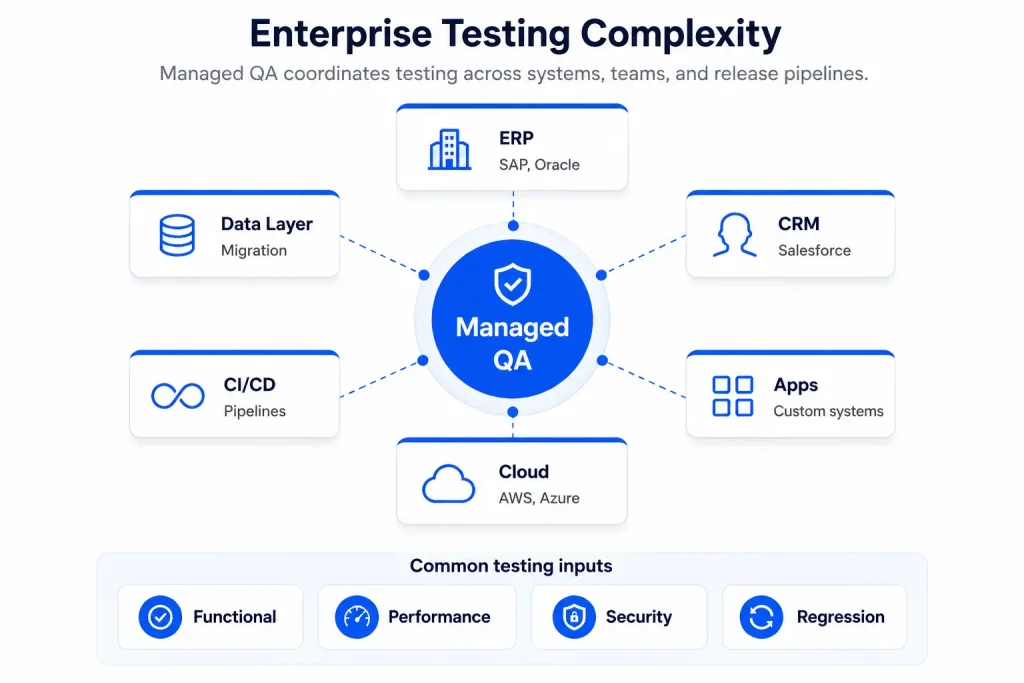
Enterprise teams need managed QA because application complexity outpaces what ad hoc testing models handle. Enterprise systems span multiple platforms, serve thousands of users, and carry regulatory obligations. Sustained QA ownership is the gap.
CISQ’s 2022 research estimates that poor software quality costs the US economy $2.41 trillion annually. Enterprise systems carry a disproportionate share. A single ERP (Enterprise Resource Planning) integration failure during migration disrupts operations across every department.
Three factors drive enterprise adoption of managed QA:
- Multi-system complexity across ERP, CRM, and custom applications.
- Compliance and regulatory requirements at scale.
- Release velocity across distributed development teams.
Multi-System Complexity Across ERP, CRM, and Custom Applications
Enterprise landscapes run on interconnected platforms. SAP, Salesforce, Oracle, Microsoft Dynamics, and custom applications exchange data through APIs, middleware, and batch processes.
Testing one system in isolation misses integration-level defects. Integration-level defects are the ones that reach production.
Managed QA teams validate end-to-end business workflows that cross system boundaries. An order placed in the CRM (Customer Relationship Management) triggers fulfilment in the ERP. The ERP generates an invoice. The invoice updates the analytics dashboard. Each handoff requires validation.
Data migration adds another layer. Moving from legacy ERP to a cloud platform requires field-level mapping validation across hundreds of tables. In our testing work with enterprise clients, data migration defects outnumber functional defects 3 to 1 during platform transitions.
Compliance and Regulatory Requirements at Scale
Regulated industries require documented evidence of testing completeness. Financial services, healthcare, and pharmaceutical companies need audit-ready traceability.
Traceability means every test case maps to a requirement. Every defect maps to a test case. Every resolution maps to a retest.
We build this into the operating model from day one. Audit readiness becomes a continuous state. Not a pre-audit scramble. Teams that treat traceability as an afterthought spend 2-3 weeks assembling evidence before every audit cycle.
Release Velocity Across Distributed Teams
Enterprise release cycles involve multiple development teams across time zones. Testing keeps pace or becomes the bottleneck.
Regression suites run overnight across distributed environments. Test results are triaged before the next business day begins. Managed QA teams integrate directly into CI/CD pipelines. Automated gates block deployments that fail critical thresholds.
Sprint-aligned testing validates each increment. The release train moves without waiting for QA to catch up.
The enterprise complexity above creates measurable cost when testing fails. The 4 benefits below quantify what managed QA delivers.
What Are the Benefits of Managed QA Services?
Managed QA delivers 4 compounding benefits that strengthen as the engagement matures. Cost drops. Defect detection accelerates. Hiring overhead disappears. Quality outcomes become predictable.
The 4 benefits:
- Lower total cost of QA operations.
- Faster defect detection across the release cycle.
- Access to specialist expertise without hiring overhead.
- Predictable quality outcomes through SLA-backed delivery.
Lower Total Cost of QA Operations
Managed QA converts quality assurance from a capital expenditure into a predictable operational cost. The provider absorbs 4 expense categories:
- Hiring and recruitment pipeline costs.
- Training, certification, and skill development.
- Infrastructure and device lab maintenance.
- Tool licensing and environment provisioning.
The client pays one fee covering the entire testing capability.
Cost reduction compounds over time. Early months carry higher costs due to ramp-up. Automation ROI materialises from month 4 onward. We routinely see regression cycles that took 3 days manually drop to 4 hours automated by month 6.
Faster Defect Detection Across the Release Cycle
Earlier detection lowers fix costs. Industry-standard benchmarks show that a defect found in production costs 100x more than one found during requirements analysis.
We see this in every engagement.
Our EdPrime team found 150+ critical bugs before the first production deploy. The edtech platform serves 5,000 concurrent users. Response time dropped 65% after we isolated performance bottlenecks during load validation.
BiteHeish, a food delivery mobile application, hit 60% API latency reduction through targeted performance QA. Test coverage reached 95% across ordering and delivery workflows.
Access to Specialist Expertise Without Hiring Overhead
Building an in-house QA team means recruiting across 4 specialisations:
- Manual and exploratory testers.
- Automation engineers.
- Performance testing specialists.
- Security testing specialists.
Each role demands different tools, certifications, and domain knowledge. A managed QA provider delivers all 4 under one engagement.
The client gains immediate access to expertise that takes 6-12 months to assemble internally.
Predictable Quality Outcomes Through SLA-Backed Delivery
SLAs define measurable quality targets. Defect leakage rates, regression pass rates, coverage percentages, and response times are documented with threshold values. The provider’s compensation ties to meeting those thresholds.
Predictability is the point.
Acts of Love, a non-profit platform, required role-based access control validation across 900 permission configurations. Our team tested every combination and resolved all 900 issues before launch. SLA-governed delivery kept the timeline intact. Teams that need this level of testing ownership can explore how our software testing outsourcing engagements are structured.
Benefits depend on engagement structure. The transition from ad hoc testing to managed QA follows 4 defined phases.
How Does a Managed QA Engagement Work?
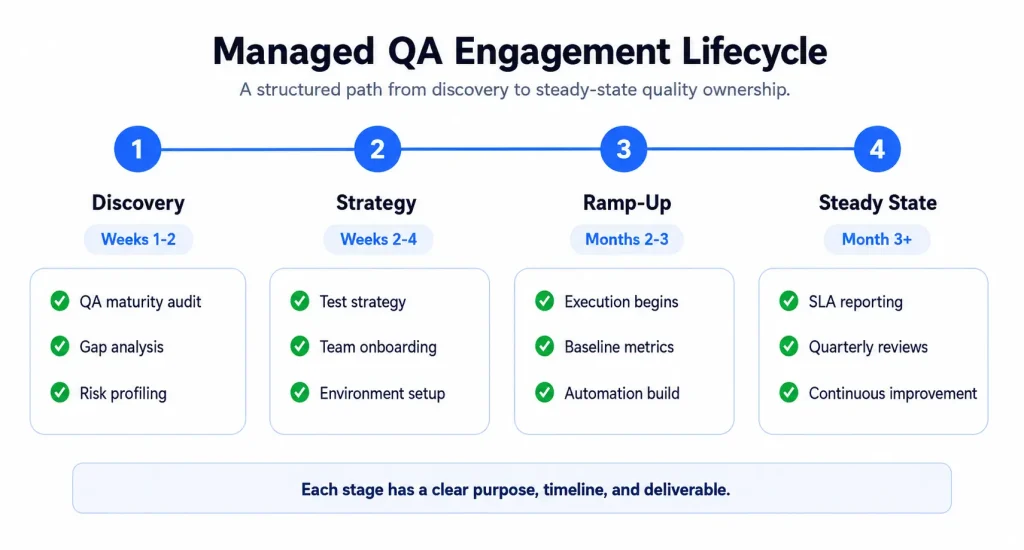
A managed QA engagement progresses through 4 phases with defined deliverables at each gate. We follow the same sequence across every engagement. Timelines vary by scope. The sequence does not.
 The 4 phases:
- Discovery and QA assessment (weeks 1-2).
- Strategy definition and team onboarding (weeks 2-4).
- Execution ramp-up and baseline (months 2-3).
- Steady-state operations and continuous improvement (month 3 onward).
Discovery and QA Assessment (Weeks 1-2)
The first step is understanding what exists. We audit existing test artefacts, automation coverage, defect history, and environment configurations.
Gap analysis identifies where coverage falls short of business risk. Most teams are surprised by the gaps. A common finding: the highest-risk modules have the lowest test coverage because they are the oldest and least documented.
Discovery produces a QA maturity assessment scored across 4 dimensions:
- Process maturity and documentation.
- Automation readiness and framework health.
- Tool utilisation and licensing efficiency.
- Team capability and domain expertise depth.
This assessment becomes the baseline for all improvement measurement.
Strategy Definition and Team Onboarding (Weeks 2-4)
The provider delivers a test strategy document. The document covers scope, coverage model, tool stack, team composition, and SLA targets. The client approves the strategy before execution begins.
Team onboarding runs in parallel. QA engineers complete domain training and environment access setup. The provider assigns a dedicated test lead as the single escalation point.
Execution Ramp-Up and Baseline (Months 2-3)
Full test execution begins. Manual and automated cycles run against the approved coverage model. The first SLA measurement cycle establishes baseline metrics.
Automation framework development accelerates during this phase. The provider builds regression suites, CI/CD integrations, and reporting dashboards. Baseline metrics from month 2 become the reference point for improvement tracking.
Steady-State Operations and Continuous Improvement (Month 3 Onward)
The engagement reaches operational maturity. Testing runs on defined cadences. SLA reporting operates monthly. Improvement cycles optimise coverage, reduce cycle time, and expand automation.
Quarterly reviews assess strategic alignment. Coverage gaps, platform releases, and changing priorities drive scope adjustments.
The engagement evolves with the product. Pricing structures determine how that evolution is funded.
How Much Do Managed QA Services Cost?
Managed QA pricing follows 3 models that balance cost predictability against scope flexibility. The right model depends on release volume and scope stability.
The 3 models:
- Fixed monthly retainer.
- Outcome-based pricing.
- Hybrid (retainer plus outcome bonuses).
Fixed Monthly Retainer
A fixed retainer covers a defined team size, tool stack, and scope. Monthly costs remain constant regardless of test cycle volume. This model suits organisations with predictable release schedules.
Offshore managed QA engagements from India typically cost 40-60% less than equivalent onshore teams in the US or UK. Retainer pricing varies by team size, geography, and scope complexity.
Outcome-Based and Hybrid Pricing
Outcome-based pricing ties a portion of the fee to measurable results. Base fees cover operational costs. Variable components reward the provider for exceeding quality targets.
Hybrid models combine a base retainer with outcome-based bonuses. Bonuses trigger when defect leakage drops below target thresholds. This structure aligns provider incentives with client outcomes.
Cost structures only matter when tied to measurable SLAs. The 6 metrics below define what a managed QA contract governs.
What SLAs and KPIs Define a Managed QA Contract?
Every managed QA contract defines SLAs across 6 measurement areas that govern quality accountability. These metrics separate managed QA from unstructured outsourcing.
The 6 metrics:
- Defect Removal Efficiency (DRE): DRE measures the percentage of defects caught before production release. Target: 95% or higher.
- Defect Leakage Rate: This metric tracks what percentage of total defects escape to production. Target: below 5%.
- Test Coverage: Coverage captures the share of requirements validated by executed test cases. Target: 90% for critical modules, 80% for non-critical.
- Regression Pass Rate: Pass rate reflects the percentage of regression tests succeeding per cycle. Target: 98% or higher.
- Mean Time to Detect (MTTD): MTTD records the average hours between defect introduction and detection. Lower values indicate faster feedback loops.
- SLA Response Windows: Response windows define the maximum time from defect report to triage. Critical defects: 2 hours. High-severity: 4 hours. Medium: 8 hours.
These targets are negotiable. Baseline measurements from the first 60 days inform realistic target-setting.
Aggressive targets without baseline data create SLA disputes in the first quarter. We set provisional targets during onboarding and finalise them after the first measurement cycle completes.
SLA metrics define contract terms. Evaluating the provider behind those terms requires a different lens.
How Do You Evaluate a Managed QA Provider?
Evaluate a managed QA provider across 5 dimensions that separate delivery capability from marketing claims. Every provider claims end-to-end coverage. These 5 dimensions test the claim.
The 5 dimensions:
- Domain expertise and platform experience.
- Engagement model transparency.
- Team stability and retention rate.
- Reporting maturity and SLA governance.
- Reference client outcomes with named case studies.
Domain expertise matters more than team size. A provider with 50 testers and deep enterprise platform experience outperforms a 500-person generalist team. Ask for case studies with named clients and specific metrics.
Engagement model transparency reveals how the provider handles scope changes, team attrition, and SLA disputes. Contracts that lack escalation paths create friction during execution.
Team stability is measurable. Ask for the provider’s QA team retention rate over 12 months. Industry average sits around 80%. Providers below that threshold lose domain knowledge faster than they build it.
Questions to Ask Before Signing
These 8 questions separate genuine managed QA providers from relabelled staff augmentation:
- What is your team’s average tenure on managed QA engagements?
- How do you measure and report Defect Removal Efficiency?
- What happens to SLA targets during team member transitions?
- Which automation frameworks do you support and maintain?
- How do you handle scope changes mid-engagement?
- What is your onboarding process for new team members?
- Do you assign dedicated test leads or rotate across clients?
- What percentage of managed QA clients renew past year one?
Renewal rates above 80% indicate delivery consistency. Below 60% signals systemic gaps.
Teams seeking targeted automation capabilities alongside managed QA benefit from providers who deliver both under one engagement.
Not every team needs managed QA. The 4 scenarios below identify when a different model fits better.
When Is Managed QA Not the Right Model?
Managed QA is not the right fit for 4 specific scenarios. Each has a better-fitting alternative. Mismatching the model wastes budget.
The 4 scenarios:
- Pre-Product-Market Fit (PMF) startups changing features weekly.
- Projects under 3 months duration.
- API-only products without user-facing interfaces.
- Teams with mature, well-functioning internal QA.
Pre-PMF teams break features on purpose. Coverage built today becomes obsolete tomorrow. Exploratory testing and developer-driven unit tests deliver more value at this stage.
Projects under 3 months lack sufficient ramp-up time. Managed QA reaches full efficiency by month 3. Shorter projects fit project-based outsourced QA better.
API-only products need contract testing and endpoint validation. Dedicated API testing fits this scope more precisely than end-to-end managed QA.
Teams with mature internal QA need augmentation, not replacement. Staff augmentation fills capacity gaps. Managed QA replaces the function entirely. Different problems. Different models.
FAQS About Managed QA Services
What Is the Difference Between Managed QA and Outsourced QA?
Outsourced QA provides testing resources. The client directs planning, prioritisation, and execution. Managed QA transfers full operational ownership to the provider. The provider controls strategy, process, tools, and team management under SLA-backed accountability.
How Much Do Managed Testing Services Cost?
Pricing varies by team size, scope, and delivery model. Offshore managed QA engagements typically range from $3,000 to $15,000 per month for small to mid-sized applications. Enterprise engagements with dedicated teams range higher based on platform complexity.
What SLAs Does a Managed QA Contract Include?
Standard SLAs cover DRE, defect leakage rate, test coverage, regression pass rate, cycle time, and response windows. Baseline measurements from the first 60 days calibrate realistic targets.
Can Managed QA Work with Agile and DevOps Teams?
Yes. Managed QA integrates into CI/CD pipelines, sprint ceremonies, and release trains. Regression suites execute on every build. Test results feed into sprint retrospectives. The model aligns with agile cadences through sprint-aligned test planning.
What Industries Benefit Most from Managed QA?
Industries with regulatory requirements and high user impact benefit most:
- Financial services and healthcare carry compliance-driven testing complexity.
- Edtech and ecommerce platforms require multi-device, high-concurrency validation.
- Enterprise SaaS products demand continuous regression across frequent releases.
Is QA Being Replaced by AI?
No. AI accelerates test case generation, maintenance, and defect prediction. AI does not replace the judgment required for test strategy, risk assessment, and exploratory testing. Managed QA providers use AI to increase coverage speed. Human QA engineers direct where testing applies.

 28 Feb 2020


