How NewU Delivered Accurate GPS Fitness Tracking Through Real-World Field Testing

Rimpal Mistry
 20/05/2026
NewU, built by RabbitQuest B.V. in Amsterdam, is a corporate wellness platform that helps employees become healthier in a personalized way and helps employers build a culture of health. More than 200 companies use NewU to run wellness programs where employees challenge each other in walking, running, and cycling, share results in a social feed, and track statistics at individual, team, and organization levels.
A fitness app that ranks colleagues against each other has one non-negotiable requirement: the numbers must be right. A GPS reading that credits a runner with the wrong distance doesn’t just produce a bug report, it breaks trust in every leaderboard the company runs. NewU partnered with Testscenario in August 2023 for an ongoing QA engagement covering the mobile apps, the employer portal, and the GPS tracking at the heart of the product.
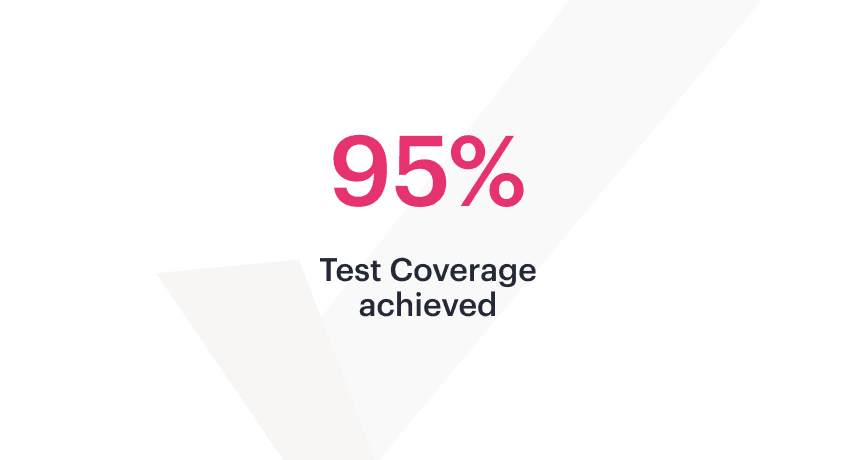
Instead of testing GPS behavior only through simulation, our team took the app outside. We walked, ran, and cycled predefined routes to validate tracking accuracy the way users actually generate it, achieving 95% test coverage across all features.
NewU’s Testing Challenges
A social fitness platform combines several testing problems that each demand different methods. The key challenges were:
- GPS accuracy under real conditions: The challenge feature depends on precise tracking of walking, running, and cycling. GPS behavior varies with speed, movement type, and signal conditions, none of which lab simulation fully reproduces.
- Social features under concurrent use: Challenge results flow into a shared social feed, so interactions, notifications, and data synchronization had to work correctly across many users acting at once on different devices and networks.
- Statistics at three levels: Every activity feeds individual, team, and organization statistics, meaning a single tracking error propagates upward through every aggregation.
- Content variety multiplying the test surface: Multiple types of challenges, habits, workouts, and recipes each carry their own logic and workflows to validate.
Goals
The engagement was structured around what a workplace wellness platform must guarantee its users and their employers.
Key objectives included:
- Validate GPS tracking accuracy across activity types, speeds, and signal conditions.
- Ensure social features behaved reliably under real multi-user scenarios.
- Confirm consistent app behavior across a wide range of devices and operating system versions.
- Verify statistics remained accurate from individual activities up through team and organization rollups.
The Solution by Testscenario
Our team built the testing approach around real-world conditions rather than simulated ones.
Solutions implemented included:
- Extensive field testing, with testers walking, running, and cycling along predefined routes to validate GPS accuracy against known distances.
- Speed-differentiated testing on the same routes, confirming the app tracked correctly whether a user strolled, sprinted, or cycled.
- Signal interference testing to observe how anomalies affected the GPS algorithm, feeding directly into algorithm optimization that filters out false readings.
- Multi-tester scenario testing of social features, exercising user interactions, notifications, and data synchronization across different devices and network conditions simultaneously.
- Cross-device validation across operating systems and versions to ensure consistent behavior on every supported device.
- Continuous testing of the employer portal alongside the mobile apps.
- QA Summary at a Glance
Types of Testing
- Field Testing (GPS validation on real routes)
- Functional
- Cross-Device Compatibility
- Multi-User Scenario Testing
- Edge Case and Negative Testing
Tools Used
- Predefined physical test routes for GPS validation.
- Client-provided test specifications, test plans, and user stories.
- Multi-device test lab across Android and iOS.
Platforms Tested On
- Android smartphones across versions.
- iOS devices across versions.
- Employer web portal on major browsers.
Results
- Field tests confirmed the app maintains high GPS accuracy across walking, running, and cycling at different speeds.
- GPS algorithm optimization, informed by interference testing, improved accuracy by filtering out signal anomalies.
- Device-specific issues surfaced during cross-device testing were identified and promptly resolved.
- Multi-tester scenarios exposed and eliminated issues in user interaction and data synchronization, producing a smoother, more reliable social experience.
- Testing reached 95% coverage across all features, with edge case scenarios identified and resolved beyond the client’s own pre-handover testing.
Key Takeaways
- Real-world testing finds what simulation misses: Walking and cycling actual routes exposed GPS behavior that no emulated location data would have revealed.
- Documentation accelerates everything: The client’s detailed test specifications, test plans, and user stories gave the team a clear scope from day one and now serve as the knowledge base for onboarding new testers.
- Edge cases prove the partnership’s value: Our reports consistently surfaced edge cases the client’s own pre-handover testing had not caught, which is exactly what an external QA partner exists to do.
- Structured client communication compounds: The documentation-driven process between our team and RabbitQuest has kept an ongoing engagement organized and efficient across its full timeline.
 04 Jun 2026